


Bevel Gear Manufacturing
Jinhua Machinery supports spiral bevel gears, bevel pinions, matched gear sets, and bevel gear shaft components for angled power transfer and compact transmission assemblies.
Request a Quote
Jinhua Machinery is a custom bevel gear manufacturer in China supporting drawing-based straight, spiral, pinion, and matched-set components for automotive and industrial programs. Review begins with the released tooth system, module, ratio, shaft angle, mounting distance, backlash, contact requirement, material, heat-treatment specification, datums, and inspection method. Documented in-house work includes CNC turning, milling, gear grinding, and dimensional or gear inspection within published ranges; the tooth-generation route is confirmed from the approved geometry and evidence before quotation. For reviewed heat-treated and ground bevel gears, published capability reaches ISO 17485 Grade 7 within module 4 and outside diameter 200 mm, subject to drawing review. Grade numbers in different standards are not assumed equivalent. Submit both mating members, assembly setting, quantity, and report requirements.
Direct answer
Jinhua Machinery manufactures made-to-drawing bevel gears, bevel pinions and matched gear sets for angled power transfer. A technical review covers tooth system, module, pressure angle, mounting distance, material, heat treatment, backlash, contact pattern, bore and face datums, quantity and inspection records. Confirmed reference capability includes heat-treated and ground bevel gears to ISO 17485 Grade 7 within the published module and outside-diameter range, subject to drawing review and final assembly contact requirements.
- Technical content reviewed by
- Process Engineering and Quality Engineering
- Last reviewed
- Capability basis
- Production records and internal inspection data
What Is a Bevel Gear?
A bevel gear transmits motion between intersecting shafts, commonly at 90 degrees, using teeth formed on a conical surface. Straight bevel gears have straight tooth traces, while spiral bevel gears use curved teeth for smoother engagement and higher load sharing. Other related geometries serve different offsets and contact conditions, so the drawing and mating set must define the exact family.
A bevel gear and pinion operate as a pair. Ratio, shaft angle, cone geometry, hand, tooth system, mounting distance, backlash, contact pattern, bearing arrangement, and housing stiffness influence the mesh. A replacement gear cannot normally be specified reliably from outside diameter and tooth count alone.
Jinhua Machinery reviews bevel gears, pinions, matched sets, and bevel gear shaft components from customer drawings for gearboxes, steering, reducers, machinery, and industrial drives. Gear design and application validation remain with the design owner.
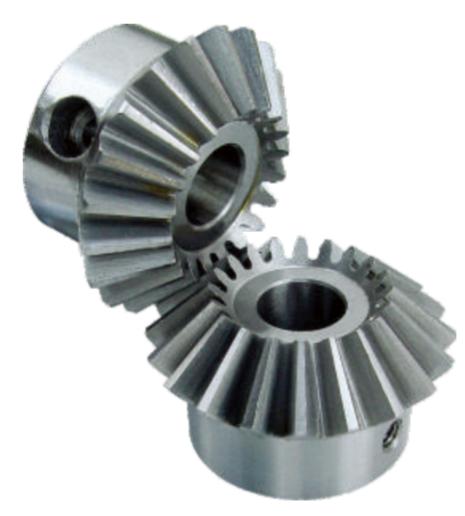
Bevel Gear Manufacturing
State whether the RFQ covers a single gear or pinion, or a matched set. Manufacturing review uses the quoted member drawing together with the released mating-member data and complete gear data; for a set, provide both member drawings. Blank type, material, heat treatment, tooth-cutting system, finishing, datums, mounting surfaces, and inspection standard are considered together. Forged or machined blanks may be used according to size, strength, geometry, tooling, and volume.
Common operations include turning and milling the blank, drilling or broaching bores and keyways, cutting bevel teeth with the specified system, heat treatment, lapping or grinding where required, deburring, protection, marking, and inspection. Spiral bevel sets may require matched processing and contact evaluation. The route depends on geometry, quality, hardness, equipment, and quantity; these are industry options rather than promises for every drawing.
Heat-treatment distortion can alter runout, mounting distance, and contact. Stock allowance, datum recovery, finishing, and set identification should be planned before tooth cutting. If gears are supplied as matched pairs, packaging and traceability must prevent mixing.
Send the member or set drawings, released mating data, ratio, shaft angle, material, heat treatment, tooth quality, contact requirements, quantity, annual demand, and reports through Request a Quote.
Tooling and data compatibility deserve an early checkpoint. A spiral bevel design can depend on a specific generating or completing method, cutter system, machine settings, and inspection calculation. The buyer should provide the released geometry source and state whether a supplier may regenerate machine data. If a physical master or existing mating member controls the design, ownership, condition, and approval responsibility should be documented before cutting production parts.
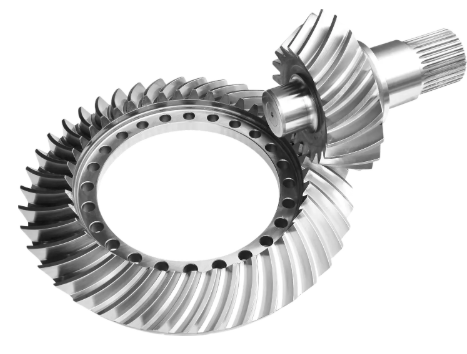
Bevel Gear Materials
Bevel gears commonly use S45C or SAE 1045 for moderate-duty, machinable designs. Higher-load gears may use case-hardening steels such as SCM415, 16MnCr5, 20MnCr5, 20CrMnTi, SAE 8620, or SAE 9310 to combine hard tooth surfaces with a tougher core. Quenched-and-tempered or induction-hardened routes may use SCM440, 42CrMo4, or SAE 4140 when the geometry and performance specification support them.
Corrosion-sensitive or light-duty bevel gears may use SUS303/303, 304, or other approved stainless grades. Industry also uses bronze, aluminum alloys, MC nylon, or POM for selected low-load, low-noise, lightweight, or lubrication-sensitive mechanisms. These materials require different allowable stress, temperature, wear, moisture, and dimensional-stability assumptions from hardened steel and should not be substituted without validation.
The pinion and gear materials must be selected as a pair with load, speed, lubrication, temperature, life, heat treatment, and contact pattern. State exact grade, standard, delivery condition, hardenability, cleanliness, certification, and substitutions. Material choice alone does not establish capacity; tooth geometry, root condition, case depth, core strength, surface finish, alignment, and lubricant all contribute.
Pinions often experience more load cycles than mating gears because they have fewer teeth, and the two members can have different section sizes and heat-treatment response. The specification may therefore use related but not identical hardness, case-depth, or core-property targets. Any intentional difference should be stated for each member instead of being implied by one assembly note.
Bevel Gear Heat Treatment
Carburizing is commonly specified for alloy-steel bevel gears requiring a hard wear-resistant case. Induction hardening can suit selected materials and geometries; quench and temper can establish through properties; nitriding may be considered when alloy and case requirements support it. Treatment must be coordinated between mating members.
Drawings should state hardness, case depth, core properties, test locations, microstructure, protected areas, decarburization, and finishing. Distortion can shift tooth contact and mounting dimensions. Lapping or grinding after treatment may be specified to restore surface and contact requirements. Certificates and metallurgical records should be agreed during RFQ.
Bevel Gear Tolerance
Bevel-gear tolerance can include profile, pitch, tooth thickness, runout, mounting distance, face angle, root angle, apex relationship, backlash, and contact pattern. The governing standard and quality grade must be named. Spiral tooth systems may also require machine-specific data and matched-member identification.
Inspection may combine analytical gear measurement, runout and coordinate checks, bore and face measurement, roll testing, backlash measurement, and tooth-contact evaluation using the mating member. Hardness, case depth, roughness, and magnetic-particle or other examinations may be required by the drawing.
Contact is sensitive to bearing, housing, and assembly position, so part inspection cannot replace final assembly validation. Define datum setup, mounting distance, contact acceptance, sampling, reports, and traceability. See quality inspection.
A useful report distinguishes component geometry from assembled setting. Bore or journal runout, face location, mounting distance, tooth deviations, and surface condition are component results. Backlash and marking contact depend on how both members are mounted. The RFQ should say which values are required per part, per set, and in the customer's housing. Set numbers or lot traceability can then connect inspection records to the packaged pair.
Where a gearset is accepted by a reference pattern, the reference should be revision-controlled and preserved with its setup data. Images should identify drive and coast flanks, load direction, compound, and mounting position. This turns a subjective visual comparison into a repeatable inspection instruction and prevents a supplier from optimizing one condition while the customer evaluates another.
Bevel Gear Applications
Bevel gears are used in automotive differentials and steering, right-angle gearboxes, power tools, construction and agricultural machinery, marine and industrial drives, actuators, and motion-control equipment. Straight bevel gears can suit moderate speed and simpler drives; spiral forms are commonly used where smoother engagement, load capacity, or noise behavior is important.
Application data should include torque, speed, duty cycle, ratio, shaft angle, direction, lubricant, temperature, housing and bearing arrangement, shock load, noise targets, and life. Installation error can move the contact pattern and concentrate load, making mounting requirements important.
Jinhua Machinery manufactures to approved drawings and does not select ratio, tooth system, or safety factor for the customer. For a single-member order, identify who supplies the mating member or reference master for any agreed set check. For a set order, identify who supplies the mounting fixture or housing reference, who defines mounting distance and shim settings, and which checks belong to supplier delivery acceptance or the customer's assembly validation.
Lubrication delivery can be especially important where sliding increases toward parts of the tooth contact. The equipment owner should define lubricant type, viscosity range, contamination limits, temperature, and direction of rotation when these affect flank modifications or surface requirements. During sourcing, this context helps explain the specification without asking the manufacturer to redesign the gearset.
Bevel Gear FAQ
Can one bevel-gear member be quoted instead of a matched set?
State whether you need a gear, a pinion, or a matched set. A single-member RFQ still needs the released mating geometry, tooth-system data, and mounting reference needed to review compatibility. If contact or backlash is part of delivery acceptance, identify the mating member or master, the setup, and who provides it.
What data is required beyond tooth count?
Provide shaft angle, ratio, tooth system, module or DP, pressure angle, hand, cone data, mounting distances, backlash, quality standard, datums, and contact requirements.
Are all bevel gears carburized?
No. Treatment depends on material, load, wear, distortion, life, and finish. Carburizing, induction hardening, through hardening, nitriding, or no hardening may be specified by design.
What bevel gear accuracy can Jinhua Machinery achieve?
Heat-treated and ground bevel gears within module 4 and 200 mm outside diameter can achieve ISO 17485 Grade 7 under the stated reference conditions. Precision bores and 0.010 mm mounting-face relationships can be combined on reviewed drawings. Other standards can be evaluated without assuming that their grade numbers are directly equivalent.
Which checks belong in bevel-gear delivery acceptance?
Define which results are required for each member, for the supplied set, and after mounting in the customer's housing. State the mounting reference, mounting distances, backlash and contact criteria, reports, and who supplies the mating member or fixture. Final assembly validation remains with the design owner.
Request a manufacturing review for Bevel Gears
Use the Contact form to send project requirements; send drawings as email attachments. Include material, quantity, tolerance, heat treatment, surface treatment, and application when available.