


Steering shaft manufacturing from drawings
Steering Shaft Manufacturing
Jinhua Machinery manufactures drawing-based steering shaft components in Changshu, China for automotive programs, including intermediate, assist, splined and related torque-transfer parts. Review begins with the controlled drawing, material, spline or serration definition, bearing and sealing surfaces, torque-critical characteristics, specified treatment and coating requirements, traceability, inspection records, validation documents and annual demand. The production and quality route is proposed only after these inputs are reviewed. Jinhua Machinery manufactures approved components; steering-system architecture, safety engineering, vehicle validation and final design responsibility remain with the customer.
Request a Quote
Direct answer
Applicable steering-shaft features can be reviewed against published shaft and bore precision ranges and the project-specific spline, runout, coating, traceability and inspection requirements. Verified machining and grinding records are retained as evidence; forming, treatment and other special-process responsibilities are confirmed for the individual route. Safety characteristics, system design and vehicle or assembly validation remain controlled by the customer drawing and agreed validation plan.
- Technical content reviewed by
- Process Engineering and Quality Engineering
- Last reviewed
- Capability basis
- Production records and internal inspection data
What Is a Steering Shaft?
A steering shaft transfers driver or actuator input through a steering column, intermediate assembly, electric power steering unit, steering gear, or related mechanism. Depending on the system, the component may provide torque transfer, telescoping movement, angular compensation, crash-management behavior, spline engagement, bearing support, or a mounting interface for assist hardware.
Steering shaft geometry can include external and internal splines, serrations, bearing journals, deep bores, cross holes, flats, threads, grooves, welded interfaces, collapsible features, and localized hardened surfaces. The released drawing must define which features are safety-critical, how the component is assembled, and which torque, corrosion, fatigue, noise, backlash, or traceability requirements apply.
Jinhua Machinery supports made-to-drawing steering shaft programs rather than standard replacement parts. Related sourcing pages include spline shaft manufacturing, input and output shaft manufacturing, forged shafts, and the broader shaft manufacturing capabilities hub.
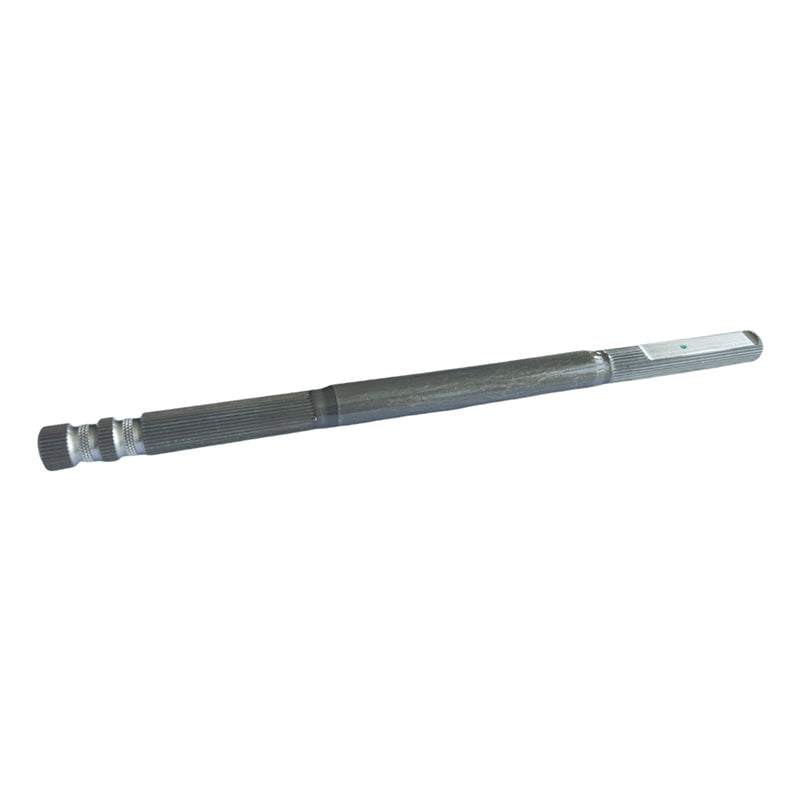
Steering Shaft Manufacturing
Manufacturing planning begins with the controlled 2D drawing, available 3D data, material specification, annual demand, program timing, validation level, and required production records. The review identifies steering-system datums, spline or serration definitions, bearing and sealing surfaces, torque paths, zones affected by heat treatment, corrosion-protection areas, marking, and any special product-safety controls.
Depending on geometry and volume, the starting form may be bar, tube, a cold-formed blank, or a hot-forged blank. A route can combine cutting, center preparation, cold or hot forming, CNC turning, milling, drilling, deep-hole drilling, spline rolling or cutting, broaching, grinding, deburring, washing, heat treatment, surface protection, laser or 2D-code marking, and final inspection. The exact sequence is selected to maintain datum relationships and manage distortion.
Prototype and pilot routes may use flexible machining and inspection fixtures; stable production volumes may justify dedicated forming and spline tools, gauges, mistake-proofing, traceability controls and protective packaging for finished splines and journals. Compare tooling, inspection and production records by route, and agree who supplies and maintains mating gauges. Process changes, tool replacement rules, approved-sample status and drawing revision control should be agreed before serial production.
Define whether the quotation covers the shaft component alone or also specified joining or assembly work, and which treatment, coating, marking, inspection records and delivery condition are included. Any additional assembly scope requires review. Jinhua Machinery reviews manufacturing feasibility; steering-system design approval and final vehicle or assembly validation remain with the customer.
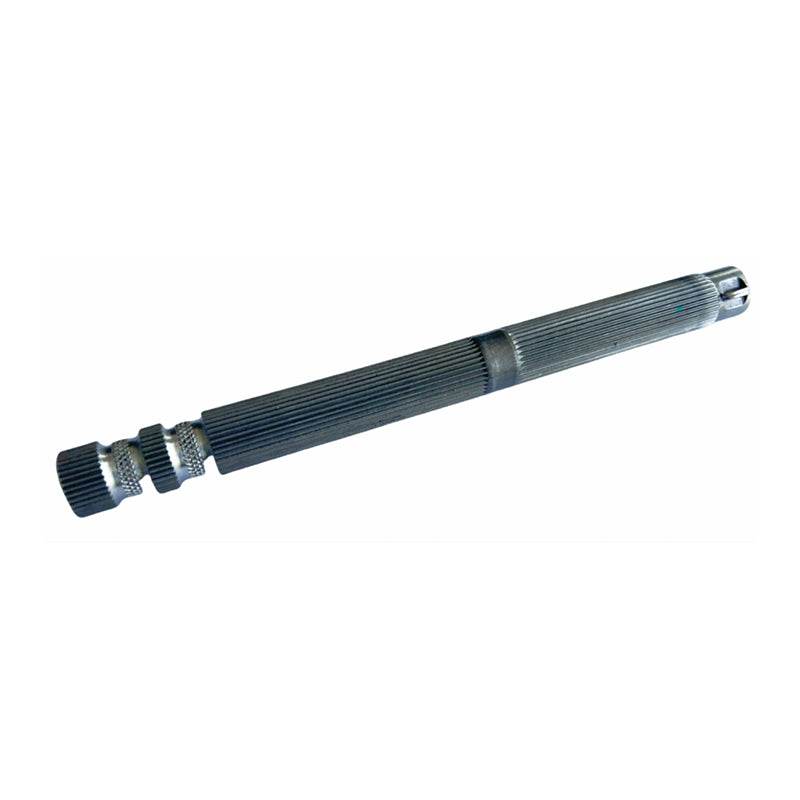
Steering Shaft Materials
Steering shafts use multiple steel families according to forming method, strength, wear, case-hardening, corrosion protection, and joining requirements. Commonly reviewed carbon steels include Chinese grades 20, 35, and 45 and SAE 1020, 1035, and 1045. Alloy grades such as 40Cr, 42CrMo, SAE 4140, and SAE 4340 may be specified where greater hardenability, fatigue strength, or impact resistance is required.
Case-hardening designs may use 16MnCr5, 20MnCr5, 20CrMnTi, SAE 8620, or another customer-approved low-carbon alloy. Cold-forming suitability depends on chemistry, cleanliness, delivery condition, spheroidization or annealing, reduction, geometry, tooling, and lubrication; a grade that forms well in one component is not automatically suitable for another. Stainless steels may be reviewed for specific corrosion-sensitive designs, but their strength, galling, forming, heat treatment, and joining behavior must be considered separately.
The RFQ should state the exact grade and governing standard, permitted substitutions, delivery condition, mechanical properties, hardenability band, cleanliness, certification, traceability, and any decarburization or metallurgical requirements. Standards named on this page are examples, not a closed material list. Other ISO, GB/T, DIN, SAE, ASTM, customer, or industry specifications can be evaluated.
Steering Shaft Heat Treatment
Steering shaft specifications may call for normalization, stress relief, quench and temper, carburizing, carbonitriding, induction hardening, or localized treatment. The choice depends on material, torque path, spline wear, core toughness, fatigue requirement, forming history, and the need for post-treatment grinding. These are drawing-defined treatment options; provider responsibility is confirmed during quotation. Zinc-nickel, phosphate, black oxide, or other corrosion treatments are separate from heat treatment and must be specified independently.
A complete requirement identifies hardness scale and range, measurement location, case depth or effective case depth where applicable, core hardness or mechanical properties, protected zones, permitted distortion, decarburization, straightness, and final finishing. Long bores, thin walls, asymmetric splines, and formed transitions can respond differently during heat treatment, so allowance and straightening strategy must be reviewed before quotation.
Required records may include furnace or batch traceability, hardness results, case-depth reports, microstructure, mechanical tests, coating thickness, salt-spray validation, or customer-specific approval documents. The customer should identify report format, sampling and retention requirements with the RFQ.
Steering Shaft Tolerance
Steering shaft tolerance must control the relationship between spline or serration features, bearing journals, bores, shoulders, mounting faces, holes and other assembly datums. Relevant controls can include diameter, roundness, cylindricity, straightness, total runout, concentricity, perpendicularity, position, spline fit, accumulated pitch, tooth or serration profile, roughness, and axial spacing.
Within the confirmed reference range and subject to drawing review, precision outside-diameter grinding can achieve a 0.005 mm total tolerance band, 0.003 mm roundness, 0.005 mm cylindricity, 0.005 mm straightness per 300 mm, and Ra 0.2 μm for diameters up to 50 mm and effective lengths up to 300 mm. Related journal or feature total runout and drawing-defined face runout can be evaluated to 0.010 mm.
For finished bores up to 30 mm diameter and L/D up to 3, fine boring or reaming can achieve a 0.009 mm total tolerance band, 0.005 mm roundness, 0.008 mm cylindricity, Ra 1.0 μm, and 0.010 mm coaxiality or total runout to the specified datum, subject to geometry and process review. Spline accuracy is evaluated against the customer standard, fit, gauges, analytical requirements and mating condition rather than one published universal grade.
Inspection may combine diameter and bore gauges, roundness and runout equipment, coordinate measurement, roughness instruments, spline gauges, analytical gear measurement, hardness testing, coating checks, dedicated fixtures and traceability records. See Quality Inspection & Process Control and define the required method, sampling, datum setup and report format before quotation.
Steering Shaft Applications
Steering shaft components are used in manual, hydraulic and electric power steering systems, including columns, intermediate shafts, assist units, steering gears and related torque-transfer assemblies. A fixed input shaft, telescoping intermediate member, assist shaft and splined output shaft have different functional priorities even when they share similar manufacturing processes.
Automotive and Tier 1 programs may emphasize product-safety characteristics, torque capacity, fatigue, corrosion resistance, spline fit, low backlash, marking, genealogy, change control, packaging and production records. Industrial steering and mobile-equipment systems may add shock load, contamination, heavy-duty duty cycles or lower-volume service requirements.
Alongside mating spline or serration data, identify the safety-critical characteristics and acceptance criteria, assembly method, torque direction and range, articulation or sliding condition, bearing support, environment and service life. The customer defines the required system validation and any regulatory or customer-specific requirements; application context does not replace the released specification.
Steering Shaft FAQ
What scope and safety requirements belong in a steering shaft quotation?
Provide the controlled drawing and available 3D model, quantities and requested delivery condition. The customer identifies safety-critical characteristics, acceptance criteria and required validation records; agree which component operations, tooling and inspection are included before quotation.
Can Jinhua Machinery manufacture both internal and external spline features?
Yes, suitable internal and external spline or serration features can be reviewed with the shaft geometry. The governing standard, fit, mating data, gauges, heat treatment and analytical inspection requirements must be provided.
Can formed blanks and finish machining be combined?
Yes. Cold- or hot-formed blanks can be combined with turning, milling, spline processing, heat treatment, grinding and finishing when the drawing, material, volume and tooling review support that route.
What steering shaft precision can be evaluated?
Published reference capability includes a 0.005 mm total tolerance band and Ra 0.2 μm on qualifying ground outside diameters, plus a 0.009 mm total tolerance band and Ra 1.0 μm on qualifying finished bores. Every feature remains subject to drawing review.
Can other customer or industry standards be reviewed?
Yes. Jinhua Machinery can evaluate ISO, GB/T, DIN, ANSI, SAE, AGMA, customer-specific and industry-specific requirements. Grade numbers are not assumed equivalent; the standard edition, datum system, measurement method and report requirements must be reviewed.
Related Manufacturing Cases
These are specific made-to-drawing examples. Their materials, processes and tolerances are component-specific and do not define a universal catalogue specification.


Request a quote
Request a Quote
Send drawings. Get a steering shaft manufacturing review.
Send the drawing and revision, material, critical dimensions and tolerances, surface and heat-treatment requirements, annual usage, batch volume, inspection or PPAP documents, packaging and delivery target.