


Spur Gear Manufacturing
Jinhua Machinery manufactures spur gears, gear wheels, toothed hubs, machined gear blanks, and related drive components for positioning, motion-control, and industrial assemblies.
Request a Quote
Jinhua Machinery is a custom spur gear manufacturer in China supporting made-to-drawing gear wheels, toothed hubs, blanks, and integral shaft components for automotive and industrial programs. RFQ review covers module or DP, pressure angle, tooth count, face width, modifications, bore or journal datums, material, heat-treatment specification, mating gear, volume, and inspection records. Documented in-house work includes CNC turning, milling, gear hobbing, gear grinding, external grinding, and dimensional or gear inspection within published ranges. For reviewed heat-treated and ground cylindrical gears, published capability reaches ISO 1328-1 / GB/T 10095 Grade 7 within module 4, tip diameter 200 mm, and face width 50 mm, with tooth surface Ra 0.8 μm, subject to drawing review. Gear shaping is evaluated only after drawing review; no accuracy grade or process is treated as a universal promise.
Direct answer
Jinhua Machinery manufactures made-to-drawing spur gears, toothed hubs, gear blanks and integrated shaft components for industrial drives and positioning assemblies. Project review covers module or diametral pitch, pressure angle, profile and lead requirements, material, heat treatment, bore and face datums, surface finish, quantity and inspection records. Reviewed cylindrical spur gears can achieve ISO 1328-1 or GB/T 10095 Grade 7 and Ra 0.8 μm tooth-surface roughness within the published range, subject to drawing review.
- Technical content reviewed by
- Process Engineering and Quality Engineering
- Last reviewed
- Capability basis
- Production records and internal inspection data
What Is a Spur Gear?
A spur gear has straight teeth parallel to its axis and normally meshes with another gear on a parallel shaft. Its geometry is comparatively direct, making spur gears common for speed reduction, torque transfer, positioning, and motion control. Straight engagement can be efficient, but tooth entry occurs across the face at once and can create more noise at higher speed than a helical mesh.
The drawing defines module or diametral pitch, pressure angle, tooth count, face width, profile shift or modification, tooth thickness, quality grade, bore, hub, keyway, mounting features, datums, and mating gear. Internal spur gears and gear racks are related but require different tooling and access.
Jinhua Machinery reviews spur gears, gear wheels, toothed hubs, machined blanks, and integral components from drawings for automotive, e-bike, bicycle, electric motor, home appliance, machinery, and industrial programs.
Spur gears may be separate wheels mounted on shafts or integral features cut directly on a shaft, hub, sleeve, or actuator component. Thin-rimmed gears, cluster gears, idlers, and internal gears introduce different support and tooling conditions. The part drawing should therefore describe the complete component rather than treating the tooth data as independent of the blank.
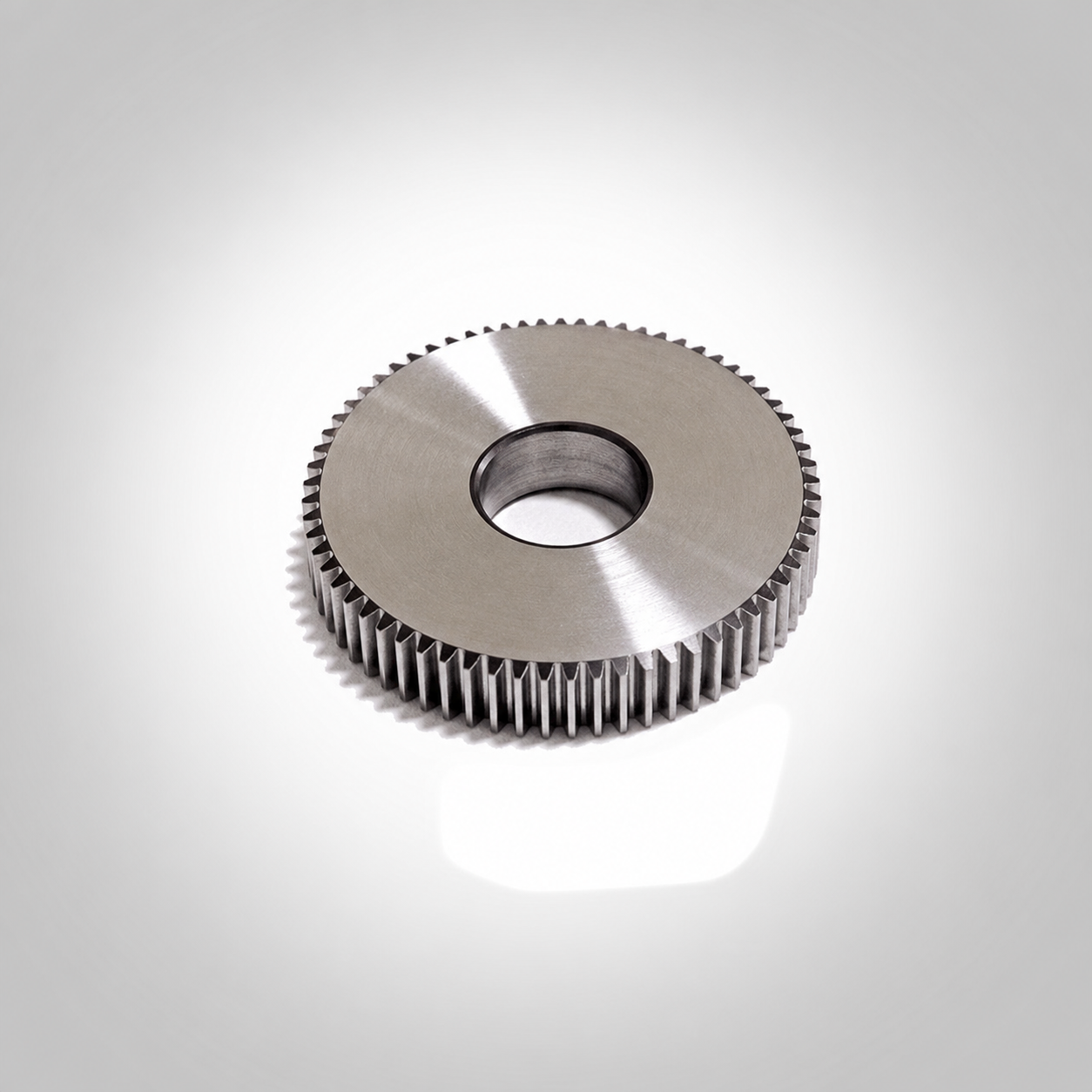
Spur Gear Manufacturing
Review begins with complete tooth data and the functional bore, hub, shaft, keyway, spline, shoulder, or hole geometry. Blank production can use bar, plate, forging, casting, powder routes, or molded materials according to the approved design, material, volume, and performance. Jinhua Machinery confirms only the route supported by the project data.
Common metal-gear operations include blank turning, drilling and milling, hobbing teeth, broaching keyways or internal features, deburring, heat treatment, grinding or honing where specified, cleaning, protection, marking, and inspection. Gear shaping is evaluated only after drawing review and is not presented as a fixed in-house capability. Interrupted teeth, thin rims, clustered holes, shoulders, and limited tool clearance can change the route.
Prototype gears may use flexible cutting and inspection, while repeated programs can justify dedicated cutters, fixtures, broaches, gauges, and automation. Heat-treatment allowance and datum recovery must be planned before tooth cutting if hardened accuracy is required.
Compare quotations for the same delivered condition: a machined blank or a finished gear, before or after the specified heat treatment and final finishing. Agree tooling and gauge responsibilities, included material or treatment certificates, gear-inspection records, protection, and packaging. A lower unit price is not a like-for-like comparison if the finished condition or acceptance duties differ. Submit the released component drawing and required quantity through Request a Quote.
Process access is checked before a tooth-cutting method is selected. A nearby shoulder may obstruct a hob, an internal form may cause gear shaping or broaching to be evaluated after drawing review, and a cluster gear may need different tools for adjacent tooth sections. Chamfers, root clearances, cutter runout space, and burr direction can affect both manufacturability and assembly. Any proposed relief or geometry change requires the design owner's approval.
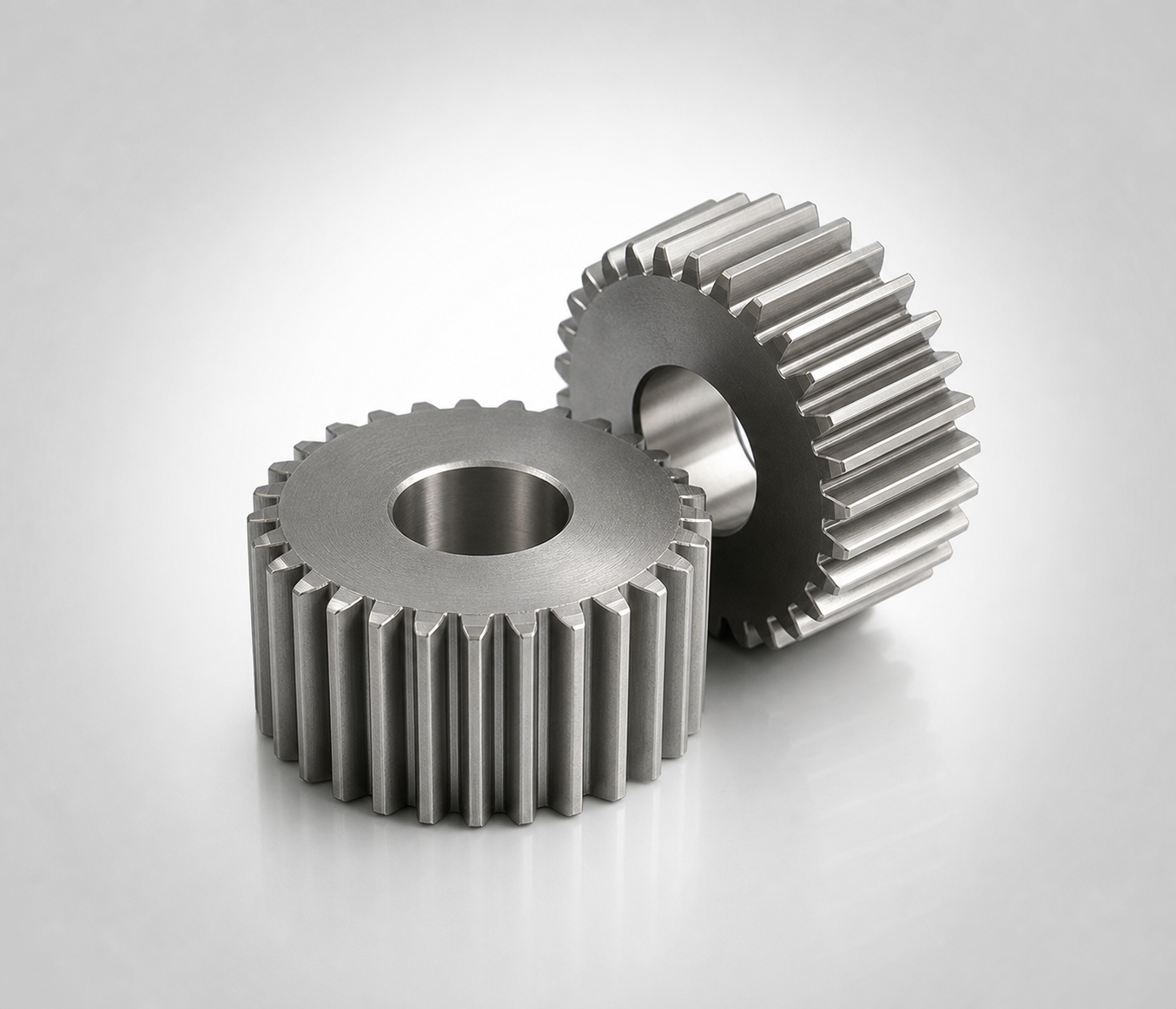
Spur Gear Materials
Spur gears can use a broad material range because load, speed, noise, lubrication, corrosion, weight, and production volume vary widely. Common steel families include S45C or SAE 1045 for moderate duty; SCM415, 16MnCr5, 20MnCr5, 20CrMnTi, or SAE 8620 for carburizing; and SCM440, 42CrMo4, or SAE 4140 for quench-and-temper or induction-hardening routes. Higher-duty designs may specify other alloy or cleanliness-controlled steels.
Corrosion-sensitive or washdown applications may use SUS303/303, 304, 316, or precipitation-hardening stainless grades when the strength and galling review permits. Industry alternatives include gray or ductile iron for damping and economical larger gears; bronze or brass for compatibility and sliding behavior; aluminum for lower mass; and POM, acetal, or MC nylon for quieter, lower-load mechanisms. Powder-metal or sintered gears can suit volume and geometry when density, fatigue, tolerance, and tooling are designed for that process.
Specify exact grade, standard, condition, certification, and substitutions. Material selection should consider tooth-root strength, contact stress, speed, lubricant, temperature, impact, rim thickness, hub design, heat treatment, and finish. Nonferrous, polymer, cast, and sintered gears are not direct equivalents to hardened steel and require design-owner approval.
Rim and hub proportions also affect the material route. A thin steel rim can move during heat treatment, while an aluminum or polymer hub can have different thermal and fit behavior from its mating shaft. If the gear is molded, cast, bonded, or assembled from multiple materials, the released specification must define the interface and validation requirements rather than relying on the tooth drawing alone.
Spur Gear Heat Treatment
Carburizing can provide a hard steel tooth case and tougher core. Induction hardening can localize hardness on suitable grades and geometry. Quench and temper or through hardening changes bulk properties. Nitriding may suit compatible alloys and controlled case requirements. Some low-load, stainless, nonferrous, or polymer gears use no conventional hardening.
The drawing should define hardness, case depth, core properties, test location, protected surfaces, decarburization, distortion, and final grinding or honing. Thin rims and asymmetric hubs can distort, changing bore, face, runout, profile, and lead. Treatment and finishing must therefore be planned with the datum scheme.
Spur Gear Tolerance
Spur-gear tolerance commonly includes profile, lead, pitch, runout, tooth thickness, quality grade, bore and face geometry, and datum relationships. Module or DP, pressure angle, and standard must be explicit. Backlash is an assembly result influenced by both gears and center distance.
Analytical gear measurement can report profile, lead, pitch, and runout. Rolling tests, span or over-pin measurements, bore and face checks, coordinate measurement, roughness, hardness, and case-depth inspection may supplement it. The measurement direction, datum, report fields, sampling, and acceptance standard should be agreed.
Numerical grade alone is incomplete without its governing standard. Mark critical characteristics and required reports; review quality inspection.
Functional inspection may use a master gear to reveal combined effects, while analytical inspection separates profile, lead, pitch, and runout. Neither automatically replaces the other. The buyer should identify the governing acceptance method, master data, test center distance, backlash or rolling conditions, and calibration responsibility. Bore and face datums must match the way the gear is located in service.
A bore that is finished after tooth cutting can change how runout is interpreted, while teeth finished after the bore may use that bore as the process datum. The drawing should identify the functional locating feature and the inspection arbor condition. For keyed gears, keyway position and fit may also need control relative to a tooth or timing mark.
Spur Gear Applications
Spur gears are common in parallel-shaft gearboxes, electric motors, pumps, actuators, machine tools, conveyors, robotics, printers, appliances, motorcycles, e-bikes, bicycles, automotive mechanisms, and industrial equipment. They serve reduction, speed increase, indexing, timing, and positioning.
High-speed service can emphasize noise, profile, pitch, runout, lubrication, and balance. Low-speed high-torque drives can emphasize root strength, case depth, rim and hub design, and shock load. Positioning systems may prioritize backlash and repeatability. Corrosive, food, or clean environments may change material and lubrication.
Provide torque, speed, ratio, direction, duty cycle, lubricant, mating gear, center distance, bearings, environment, life, noise, quantity, and annual demand with the drawing. Final gear design remains the customer’s responsibility.
Packaging is part of quality preservation for finished gears. Teeth, precision bores, and ground faces should be protected from impact, corrosion, and mixed-part damage. If gears are delivered in trays, counted lots, or assembly-oriented positions, those details should be included with quantity and destination because they can affect cleaning, protection, and unit cost.
Spur Gear FAQ
What spur gear data is required for quotation?
Provide module or DP, pressure angle, tooth count, face width, profile modifications, quality standard and grade, tooth thickness, datums, mating gear, backlash, material, treatment, and inspection.
What is the difference between module and diametral pitch?
Both describe tooth size using different systems. Module is metric-based; diametral pitch relates teeth to pitch diameter in inch units. The drawing must use one clear convention.
Are spur gears always made from steel?
No. Steel, stainless, cast iron, bronze, aluminum, and polymers are industry options. Load, speed, wear, noise, environment, lubrication, and cost guide the design choice.
What spur gear accuracy can Jinhua Machinery achieve?
Heat-treated and ground spur gears within module 4, 200 mm tip diameter, and 50 mm face width can achieve ISO 1328-1 or GB/T 10095 Grade 7 and Ra 0.8 μm tooth surfaces. Precision bores and mounting-face relationships can be combined on reviewed drawings, and other customer-specified standards can be evaluated.
Can prototype and production routes differ without changing acceptance?
They may differ, but the released geometry, material, treatment, functional requirements, and inspection basis remain controlling. Identify proposed route or tooling changes and obtain design-owner review if they affect the agreed requirements; a prototype approval does not approve an unreviewed change to the delivered condition.
Request a manufacturing review for Spur Gears
Use the Contact form to send project requirements; send drawings as email attachments. Include material, quantity, tolerance, heat treatment, surface treatment, and application when available.